
The Things That Captivate Us
Peculiar How Things Occupy Your Mind
You never really know when or why something is going to captivate you. I suppose it must be because it touches something inside of you, something that was probably there all along, though you might have a hard time explaining just what it is. Whatever the reason, I think most everybody has experienced it at one time or another. Something catches your attention, and then it holds it, and before long you find yourself thinking about it all the time. You get a little obsessive about it, I guess. That's happened to me a few times in my life.
When I was young, it was Milwaukee Brewers baseball.
I was talking to my brother the other day, after the World Series, and we got to remembering some of those years. I can still vividly recall lying in my room at night listening to Bob Uecker call Brewers games. I'm old enough to remember when a Walkman was new technology, and I'd lie there in bed, lights off, with those headphones on, listening to Ueck.
And the funny thing is, if you listened closely enough, you could hear everything. The crack of the bat, the hot dog vendors hollering in the stands, the crowd rising and falling with whatever was happening on the field. All those little sounds that made baseball what it was. Uecker had a way of calling a ballgame that made you feel like you were sitting right there, and I've often thought he was less a broadcaster than a storyteller. Every night he'd tell you a story that lasted about three hours, and it made you feel like you had nowhere else to be in the world.
I was captivated by it. I'd stand in front of the mirror practicing my swing before getting ready to go to my own Little League games. I suppose every kid who loved baseball did something like that.
When I got a little older, I still enjoyed baseball, but football began to take its place. The high school I attended had one of the best football programs in the state, and had been that way for a good many years. I dreamed of playing for them. When I finally got the opportunity, it was everything I'd hoped it would be, and probably a good deal more. I loved it enough that I eventually became a football coach myself, something I've now been doing for over 25 years. There are Friday nights from those years that I remember as clearly as if they happened last Friday. Strange how that works. You forget all sorts of things as you get older, things that probably ought to matter, but you can remember something that happened on a football field twenty or thirty years ago right down to the smallest detail.
But life moves along, as it has a habit of doing. You get older, get married, have children, and the things that once occupied so much of your time gradually give way to other things. Most of your free time becomes devoted to helping your children find their way through their own lives and captivations.
My wife and I have been to just about every hockey rink and softball field within three states of our house, or at least it seems that way. And I wouldn't trade any of it. There's something special about watching your children find the things they love, and then being able to share those things with them. I hope everybody gets to experience that somewhere along the way. Those are the memories that stay with you, and I suspect we'll still be telling the same stories twenty or thirty years from now.
Remember when?
My youngest child graduated from high school last spring, and I suddenly found myself with a whole lot of free time on my hands. My wife and I had to figure out how to make supper for two instead of three or four or five. That's a stranger adjustment than you might think. The hockey rinks and softball diamonds gave way to slower weekends, a quieter house, and a little more time together.
But I've come to think that when something leaves a void in your life, that void doesn't stay empty for very long. Your mind has a way of finding something to fill it. It might take a while, and you might not recognize it when it first comes along, but eventually something else will catch your attention.
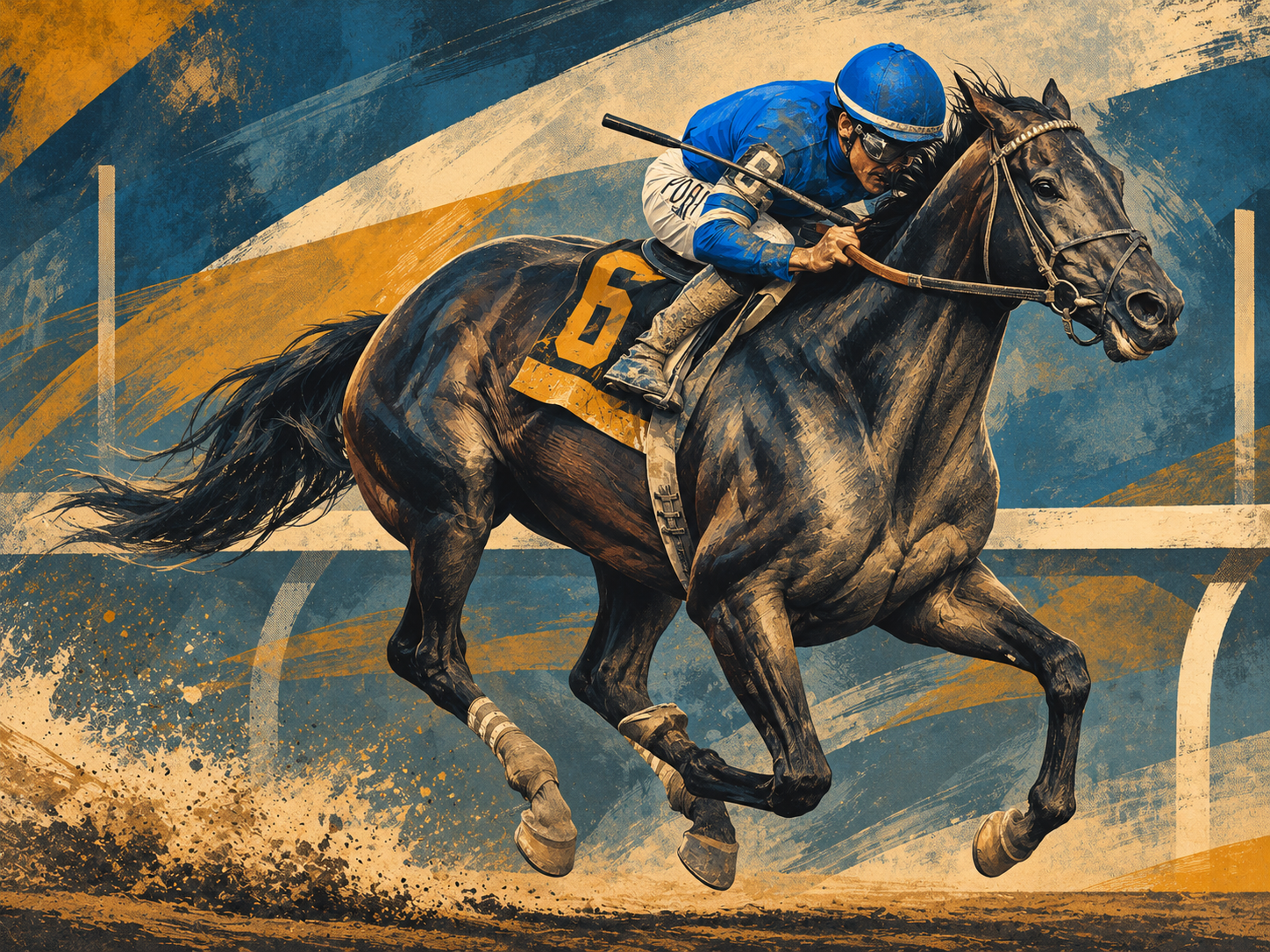
For me, that something turned out to be horse racing.
Now, I don't have one of those stories about growing up around the horses at Saratoga or Del Mar, that’s not my life. I always enjoyed the Triple Crown though. The first one I really remember following was the battle between Sunday Silence and Easy Goer in 1989. I can't say I've watched every Kentucky Derby since then, but I've tried to catch as many as I could. And for years that was about the extent of it.
Every so often I'd try to follow horse racing a little more closely, but I always had a hard time making sense of the sport beyond those few weeks in the spring. I didn't know the horses, couldn't tell you which races mattered or why, and had no real understanding of how it all fit together. I'd watch a race, enjoy it, and then have no idea what I was supposed to be following next.
This spring I decided I was going to figure it out.
I don't know that I had any particular plan. I just started reading things and digging around on YouTube, watching old races and listening to people who knew considerably more about the sport than I did. One thing led to another, as these things usually do, and after a while it began to make sense.
I started recognizing horses that I'd seen run before. I began to understand the different classes of racing, why certain horses were suited to certain distances or surfaces, and why a particular race might matter more than another. Then there was the breeding side of it, the auctions, the owners, the trainers, and the history. Especially the history. There's an awful lot of history in horse racing, and the more you learn about it, the more you realize how much there is left to learn.
I think I've listened to just about every Audible book there is on the subject, though I'm sure somebody will tell me about one I've missed.
By the time summer came around, and without a softball field I needed to be at, I found myself watching horse racing in the afternoons. My daughter and I would talk about the horses, which ones we liked, and which races were worth watching. I told her she needed to pick out a favorite horse, and she did.
Sovereignty.
That gave us something else to talk about, and before long we were following him together. My wife, our daughter, and I went up to Churchill Downs for Stephen Foster Day, and we had a wonderful time. The track was a little sloppy, but the rain mostly held off, and it was one of those days you remember because everybody enjoyed themselves. There wasn't really anything complicated about it. We were just there, together, enjoying the races.
Now, I've always been something of an analytics person. I've spent a good part of my life wondering how things could be done better, how to make something more efficient, or how to do more with less. I've always been interested in the numbers behind sports and what they might tell us that we couldn't otherwise see. Moneyball was a good movie, and an even better book, and the whole idea of using data to understand something that people have been doing the same way for generations has always appealed to me. So naturally, after I'd spent enough time watching these horses run, a thought landed in my brain. Could I build an accurate horse racing model?
I didn't know. But I figured there was one way to find out.
And that's really where this whole thing began.
I started digging through the data and trying to understand what mattered and what didn't. I'd build something, test it, find out where it was wrong, and go back and try again. Sometimes an idea that seemed perfectly sensible turned out to be worth very little. Other times something I hadn't thought much about would turn out to be important. And every time I thought I had something figured out, I'd discover three or four more things I didn't understand.
Before long I was spending twelve, sometimes sixteen hours a day working on it. I know that sounds a little ridiculous, and I suppose it probably is. But the hours went by without my noticing them. I'd sit down to work on one thing and find myself, six hours later, still trying to answer a question I hadn't even thought to ask when I started.
I was captivated again.
I don't suppose the model will ever really be finished. There's always going to be another thing to test, another piece of information to consider, or something I think I can improve. That's probably just the nature of it, and I'm perfectly content with that. I enjoy the work. I enjoy watching the races and seeing how the model performs. And I enjoy the feeling that, every now and then, I'm beginning to understand a little more about a sport that seemed so mysterious to me not all that long ago.
Maybe this is what becomes my passion for the second half of my life. I don't know. I've been around long enough to know that you can't always predict those things.
But that's why Rail & Rye is here, and why the Thoroughbred Racing Intelligence project exists. It began with my wanting to understand horse racing a little better, and somewhere along the way it turned into something considerably bigger than I'd imagined.
I don't pretend to know where it'll all lead. I'd like to think I might do some small part to help a sport that has such a wonderful history find its way to a new generation of people. Perhaps the things I'm building here will help somebody else understand what they're watching, or appreciate something about the horses and the people behind them that they might otherwise have missed.
And maybe somebody will come across this site who, like me, enjoyed watching the Kentucky Derby every spring but never really knew what to make of the rest of it. Maybe they'll stick around long enough to figure it out.
And maybe, somewhere along the way, they'll find themselves captivated too.