

A Neck Between Them
At Mountaineer, a projected running shape and two different sets of probabilities found their way onto the same result chart
Priority Lane had the lead passing the opening quarter in the November 2 finale at Mountaineer, just where Rail & Rye's projected running shape had expected to find him. The five-year-old gelding was the horse to catch. Bohemian Style figured to be among those keeping him honest, while Lomachenko was expected to settle within striking distance of the principal speed.
The race began to take shape along those lines. Reynaldo Dumont sent Priority Lane through the opening quarter in 22.71 seconds. Lomachenko chased from second, with Bohemian Style close behind. By the half-mile, reached in 46.42, Bohemian Style had moved into second. Lomachenko was third, two and a half lengths from the leader, with much of the running still ahead of them.
Bohemian Style had done plenty of work himself. His pursuit began to take its toll on the turn. He was five and a half lengths away at the stretch call and would finish last, beaten fourteen and a half. Lomachenko took over second and began to close on Priority Lane, who still held a narrow advantage. In the final strides they were tight, but the leader answered once more. The wire arrived with Priority Lane a neck in front.
Lomachenko was three lengths clear of Team Leyendecker in third. The $2 exacta, 4–2, returned $39.60.
There was something particularly satisfying about the result beyond having selected the winner. Rail & Rye's projected running shape had anticipated the principal horses' early positions, and its two probability models had offered different opinions about how those horses might finish.
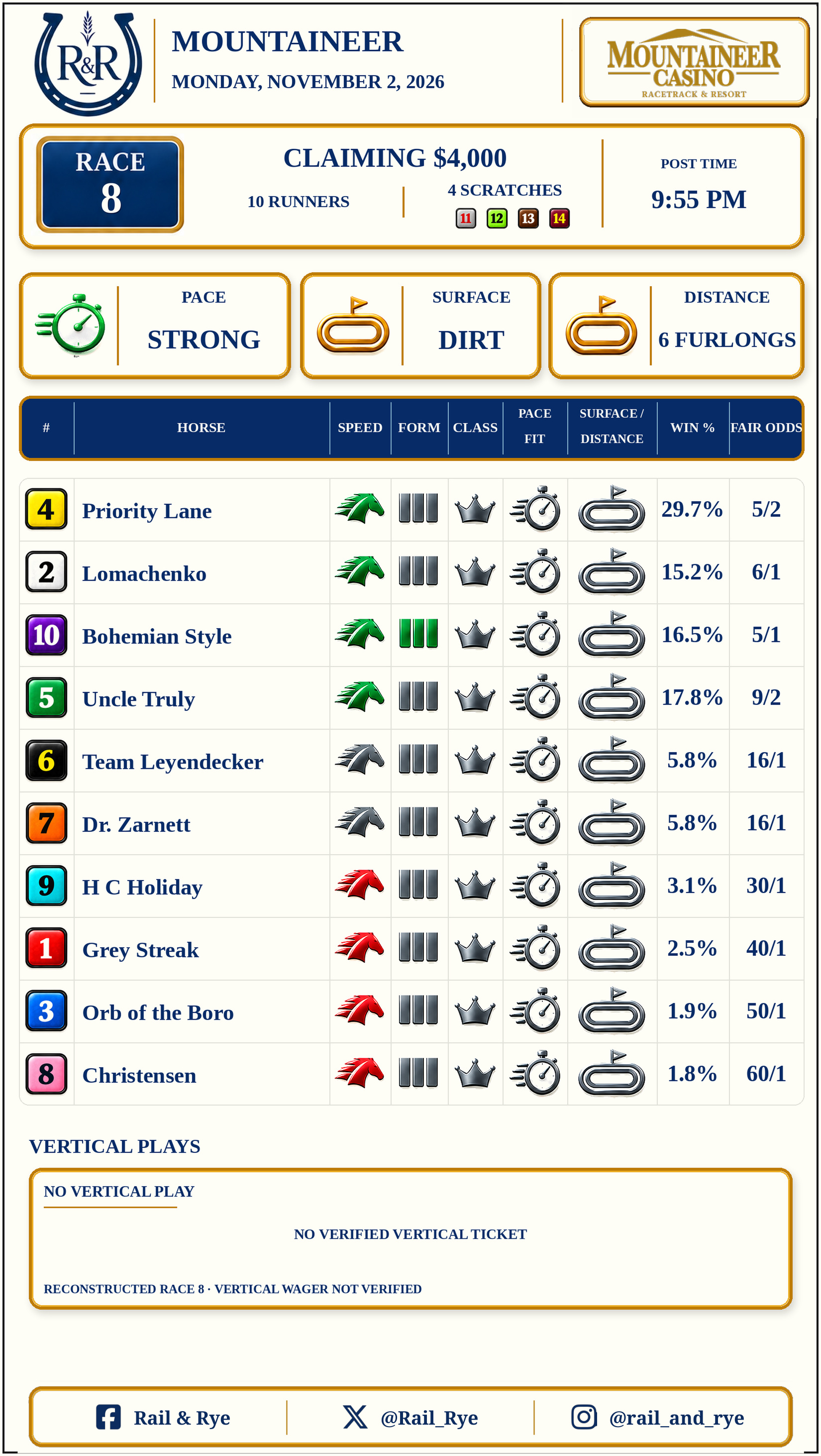
The Thoroughbred Racing Intelligence model preferred Priority Lane to win, assigning him a 29.7% win proability. Uncle Truly and Bohemian Style came next, while Lomachenko stood fourth at 15.2%.
But Lomachenko wasn't fourth in our projected finish order.
Our finising order engine gave him a 17.7% chance of finishing exactly second, the highest in the field. Bohemian Style followed closely at 17.3%. With Priority Lane winning, the conditional model rated Lomachenko a 22.1% chance of taking second, narrowly ahead of Bohemian Style at 22.0%.
The advantage was small surely, but its origin is important. Our finish-order model retains the Thoroughbred Racing Intelligence's win probabilities while evaluating the remaining positions separately. Historical evidence had taught it that a horse ranked fourth for winning could carry different prospects for finishing immediately behind another winner. In this field, that learned adjustment was just sufficient to lift Lomachenko above Bohemian Style for second.
Lomachenko's previous performances offered evidence of a horse capable of sustaining his effort in this company. Seven earlier Mountaineer dirt starts had produced a victory, two seconds, and two thirds. Our projected running shape placed him close enough to the speed to participate without necessarily becoming involved in the contest for the early lead.
He ran almost precisely that sort of race.
Bohemian Style was the one who paid for chasing Priority Lane. Lomachenko remained within reach, advanced as the pressure began to show, and made the winner fight for every inch of the final furlong. Priority Lane had enough left to withstand the challenge.
The public's 2–1 favorite, Uncle Truly, finished sixth. Bohemian Style, the 7-2 second betting choice, finished tenth. Priority Lane held on at 9-2, and Lomachenko, sent off at 5-1, ran the race of the closest pursuer.
A single result cannot establish the long-term merit of a predictive model. There will be afternoons when the projected pace dissolves at the break and evenings when a promising runner-up fails to find his stride. But November 2 at Mountaineer provides an unusually clear example of how the pieces of our handicapping work can fit together.
We anticipated the broad running shape. Our win model favored the horse who controlled that shape. Our finish-order model elevated a different horse for second, even though he stood only fourth among the winning candidates.
There was a neck between Priority Lane and Lomachenko at the wire, and three lengths between Lomachenko and everybody else. For one November evening at Mountaineer, the distinctions in our forecasts were plainly visible in the result.